

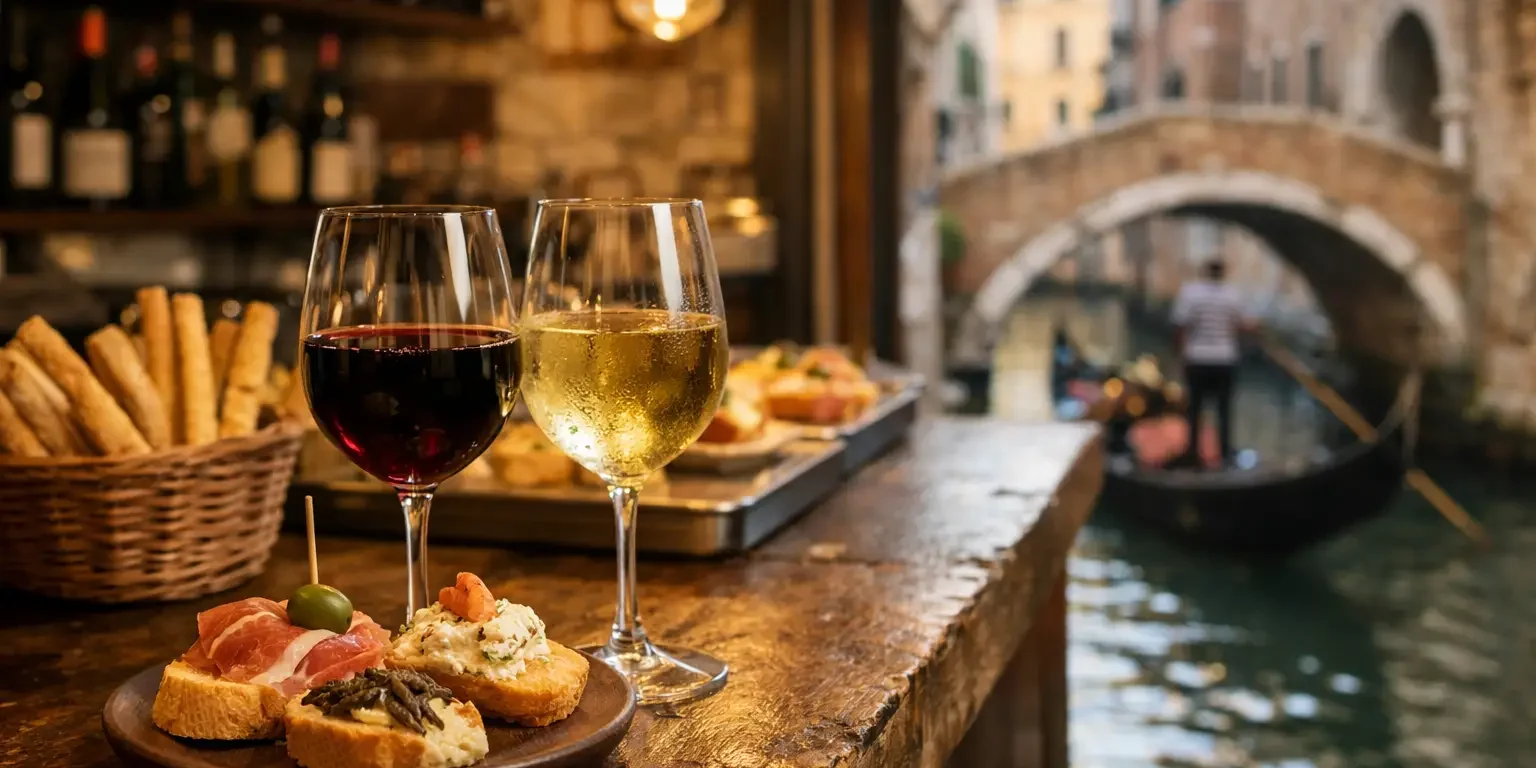
A polished dinner in Venice has its place, but there is another ritual that reveals the city more intimately. Bacaro, the typical wine bar, is where Venice relaxes into itself – where a glass is poured without ceremony, a small bite is chosen at the counter, and the room fills with the low, easy rhythm of local conversation.
For travelers who want more than a checklist of landmarks, the bacaro offers something rare: a sense of participation. It is not simply a place to eat or drink. It is a social institution woven into Venetian daily life, one of the most enjoyable ways to experience the city with elegance, spontaneity, and genuine local character.
What is bacaro, the typical wine bar?
A bacaro is Venice’s traditional wine bar, informal in style yet deeply rooted in the city’s culture. The atmosphere is often compact, lively, and unpretentious. Guests gather for a glass of wine, known locally as an ombra, and a selection of cicchetti, the small savory bites that define this style of eating.
The appeal lies in its balance. A bacaro can feel casual, but it is never careless. Behind the simplicity there is often remarkable attention to ingredients, seasonality, and regional identity. Salt cod, marinated seafood, creamy baccalà, artichokes, cured meats, local cheeses, and beautifully prepared vegetables may all appear on the counter, depending on the season and the house.
For many visitors, that is the first surprise. The bacaro is not a theme built for tourists. At its best, it remains part of everyday Venetian life. Office workers stop in before dinner. Friends meet for a quick glass. Families and longtime residents mark the end of the day there. That lived-in quality is exactly what makes it memorable.
Why the bacaro matters in Venice
Venice can be experienced in two very different ways. One version is grand and ceremonial, shaped by famous piazzas, palaces, and museum visits. The other is more subtle. It reveals itself in quiet calli, neighborhood rhythms, and places where the city still feels personal. Bacaro, the typical wine bar, belongs firmly to that second Venice.
It matters because it reflects the city as residents know it. The format suits Venice perfectly: compact spaces, a maritime food culture, and a social style that values short, convivial stops over long, formal meals every night. In a city built around trade, exchange, and movement, the bacaro feels almost inevitable.
There is also a practical elegance to it. You are not committing to a large meal, a long reservation, or a fixed menu. You can stop for one glass and one bite, or gradually turn the evening into a moving experience, trying a few specialties in different places. Some travelers love that freedom. Others prefer the comfort of settling into one excellent spot. Both approaches work.
The pleasure of cicchetti and ombre
To understand the bacaro, it helps to understand its two defining elements: cicchetti and wine. Cicchetti are small plates or bites, but that description can sound more generic than the experience really is. In Venice, these little offerings are expressions of local taste and kitchen personality.
Some are simple and direct, such as crostini topped with whipped cod or anchovy. Others are more substantial, including meatballs, fried vegetables, seafood salads, or small sandwiches. Presentation varies from rustic to polished, depending on the house. The common thread is that each piece is meant to complement conversation rather than interrupt it.
Then there is the ombra, traditionally a small glass of wine. The custom is refreshingly unfussy. Wine is part of the rhythm, not a performance. That said, quality still matters, and many bacari take pride in thoughtful selections from Veneto and beyond. If you enjoy wine but prefer settings that feel relaxed rather than formal, this is one of Venice’s quiet pleasures.
There is no single correct order, and that is part of the charm. You may choose by appearance, ask for the house specialty, or simply follow what the regulars are having. The pleasure comes from curiosity as much as appetite.
How to enjoy a bacaro well
The best bacaro experience begins with the right mindset. Do not expect a full restaurant structure in every case, and do not judge a place by how polished or spacious it appears from the outside. Some of the most rewarding stops are compact, bustling, and easy to overlook.
Timing makes a difference. Earlier in the evening, the atmosphere can feel more local and relaxed, while later hours may become busier and more social. Neither is better in absolute terms. It depends on whether you want a calm introduction or a livelier mood.
Standing at the counter is common, and in many places it feels more authentic than seeking out a formal table. That said, comfort matters. If you prefer a seated experience, there are bacari that offer a more leisurely approach. Venice rarely insists on one style only.
A thoughtful strategy is to keep the experience light and progressive. Instead of turning the first stop into a full dinner, enjoy a glass and a few cicchetti, then continue your walk through the neighborhood. This creates a more fluid evening and lets the city unfold between stops. The short walk from one bacaro to another is often as enjoyable as the food itself, especially when the streets begin to quiet and Venice takes on its evening glow.
What distinguishes a good bacaro from a forgettable one
Not every traditional-looking wine bar offers the same level of character. The best bacari feel rooted rather than staged. You notice it in the rhythm of service, the freshness of the offerings, and the natural mix of guests. A place does not need to be old-fashioned to feel authentic, but it should feel connected to Venetian habits rather than designed solely around outside expectations.
Quality reveals itself in small details. Cicchetti should look fresh, not tired. The wine selection should feel considered, even if the format stays informal. Service should be efficient and welcoming, with confidence rather than pressure. The atmosphere may be busy, but it should not feel chaotic for the sake of image.
There is also a matter of proportion. Some bacari preserve their intimacy beautifully. Others become so well known that the experience can feel crowded and hurried. Popularity is not a flaw, but if your priority is ease and refinement, it may be worth choosing a quieter neighborhood moment over the most photographed address.
A more refined way to experience local Venice
For travelers who value comfort and authenticity in equal measure, the bacaro fits naturally into a well-planned Venetian stay. After a day spent among masterpieces and grand architecture, there is something deeply satisfying about stepping into a smaller, more human setting where the city feels immediate and uncurated.
This is one reason guests who stay in residential-style accommodations often enjoy bacari more fully. Returning to Venice as if returning home changes the rhythm of the day. You are not rushing to fit every experience into a rigid itinerary. You can pause, wander, choose a bacaro on instinct, and let the evening develop naturally. In the San Marco area, this kind of flexibility is particularly valuable because it allows you to move between the city’s celebrated highlights and its quieter pleasures with unusual ease.
At Ca’ Sant’Angelo, that balance between refinement and lived experience is part of the spirit of a Venetian stay. The city is at its most memorable when it feels both elevated and personal.
Bacaro, the typical wine bar, as a cultural ritual
What stays with many visitors is not only the flavor but the mood. A bacaro teaches you something about Venice without announcing itself as a lesson. It shows how sociable the city can be, how much pleasure Venetians find in brief encounters, and how strongly food and place are linked.
There is a certain grace in this format. It resists excess. Portions are modest, moments are shared, and quality matters more than display. That sensibility feels especially Venetian – cultivated, practical, and quietly confident.
If you are choosing how to spend an evening in Venice, make room for this experience. Skip the urge to overplan. Let a glass of wine, a few carefully chosen cicchetti, and a welcoming room introduce you to the city at its most genuine. Often, that is where Venice feels richest.